Taihang Mountains
The Dark ForestThe Taihang Mountains are the landscape that frames one of Luo Ji’s rare experiences of unplanned freedom and, centuries later, one of his most searching reflections on memory and human impermanence. First encountered as a distant range during a westward drive with Zhuang Yan, they become the terminus of a day spent without a destination. When Luo Ji revisits them after more than two hundred years, the mountains have scarcely changed while the human world around them has become desert. Their geological persistence gives the location a significance beyond scenery: the mountains hold a human moment in memory while placing that moment against a timescale in which entire civilizations are brief and nearly weightless.
Setting and Physical Character
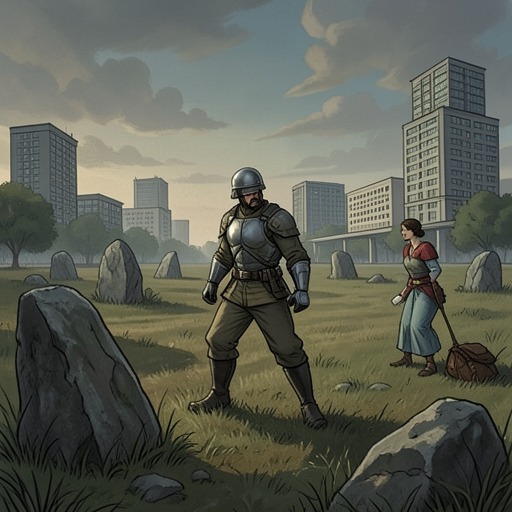
The mountains appear first from the northern China plain, running parallel to the road before bending around to form a western barrier. Luo Ji identifies them for Zhuang Yan as they approach, and the road eventually carries them into the range. The landscape is not presented as dramatic alpine wilderness. The mountains are plain and ordinary in shape, covered only by withered grasses and vitex vines lodged in the crevices of gray rock. Their apparent weariness becomes the governing image of the place: over hundreds of millions of years, they seem to have tired of standing, sunk into flatness, and acquired the stillness of something that has outlasted activity itself.
The road through the range is irregular and unhurried. Sheep repeatedly stop the car, and the travelers pass villages with cave houses, persimmon and walnut trees, low stone-tiled buildings, and roofs piled high with stripped corn cobs. These settlements differ from the modernized hamlet they had passed earlier, where new houses, broad cement roads, cars, city clothing, and even familiar urban dogs had made the countryside feel indistinguishable from the city. In the Taihang Mountains, the landscape finally resembles the countryside they had imagined, while the larger setting turns their journey into a gradual movement away from standardized urban life and toward an older, rougher environment.
The Winter Journey
Luo Ji chooses the westward road simply because it avoids the trouble of crossing the entire city. The choice has no strategic purpose and no fixed destination. As buildings thin and fields appear, he opens the car window to the cold winter air. The journey’s emotional force lies precisely in its lack of a plan: for the first time, he feels the freedom of traveling without knowing where he will end up, accompanied by Zhuang Yan and by the sensation of her long hair blowing across his temple.
Before entering the mountains, they stop to watch magpies forage at the edge of a field. The birds retreat toward distant trees when the pair draws near. They then descend into an almost dry riverbed, where only a thin stream remains, gather small, smooth, chilly stones, and throw them through the thin ice, watching cloudy yellow water pour through the openings. At a market in a small town, Zhuang Yan becomes absorbed in a goldfish vendor’s bowls, where the fish gleam like liquid flames beneath the sun. Luo Ji buys two goldfish and places them, still in their water, in plastic bags on the backseat.
Their wandering continues through an ordinary village with an unexpectedly enormous empty stage. Luo Ji climbs onto it and sings a verse of “Tonkaya Ryabina” about the slender hawthorn tree to Zhuang Yan, his only audience. They eat in another town, finding the food much like city food except that the portions are roughly twice as large, rest sleepily in the sunlight outside the town hall, and continue onward. The mountains therefore receive not a formal expedition but a sequence of small, purposeless acts: stopping, looking, collecting, singing, eating, and driving on.
The Ridge and the Shared Image
The road enters the mountains before the pair realizes that the entire afternoon has passed. Near sunset, Luo Ji drives along a potholed dirt road to a high ridge where the light still reaches them, while the road below has already fallen into shadow. They decide that the ridge will be the journey’s endpoint: they will watch the sun set and then return. Zhuang Yan’s hair moves in the evening breeze as though trying to catch the last golden rays, an image that joins the human figure to the vanishing light without making the landscape merely decorative.
Zhuang Yan gives the mountains their most memorable human comparison, describing them as old villagers basking in the sun. The image fits the range’s flattened forms, exposed gray rock, and profound ease, but it also reveals the difference between human rest and geological duration. The travelers had not found villagers as relaxed as the mountains in the settlements they crossed. The mountains possess a stillness that human beings can imitate only briefly, during an afternoon when they have temporarily abandoned purpose.
Return Across Two Centuries
When Luo Ji later returns to the twilight mountains, he recalls that winter night more than two centuries earlier and Zhuang Yan’s image of the old villagers. By then, the fields and cities of the northern China plain have become desert. The mountains, however, remain visually almost identical: the same ordinary contours, the same withered grasses, and the same vitex vines growing stubbornly from the gray-rock crevices. Two centuries are too short to produce a visible change in such a landscape.
This return transforms the mountains from the setting of an intimate excursion into an instrument for measuring historical loss. Luo Ji’s life has been divided into two radically different portions, and the era after he became a Wallfacer has passed with the compressed unreality of a dream. His memories of his wife and child are too painful to approach, while the details of his earlier life survive only as fragments whose feelings have disappeared. Against that damaged interior history, the mountains provide continuity. They preserve the material circumstances of a remembered scene even when the human attachments within it have become difficult to recover.
Human Scale and Narrative Significance
From the mountains’ imagined perspective, human civilization appears as a short sequence: small living beings emerge on the plain, multiply, erect structures like anthills, illuminate them, produce smoke, and then vanish as the lights and smoke disappear. The structures collapse and are buried in sand. This imagined view does not grant the mountains human consciousness so much as use geological duration to strip human history of its assumed centrality. Cities and civilizations that seem immense from within human time become temporary marks on the surface of a much older world.
The Taihang Mountains consequently carry two temporal meanings at once. They are the place where Luo Ji and Zhuang Yan briefly escape schedules, objectives, and social density, and they are the place that survives the disappearance of the world that made their excursion possible. Their unchanged rocks hold the outline of a personal memory, but their endurance also exposes the limits of memory: Luo Ji can recover the mountain scene more clearly than much of his own life. The range stands as a quiet counterforce to human plans, relationships, and civilizations, giving the narrative a landscape in which intimacy is real precisely because it is temporary.